
i
n
f
l
a
r
x
Loading
Loading

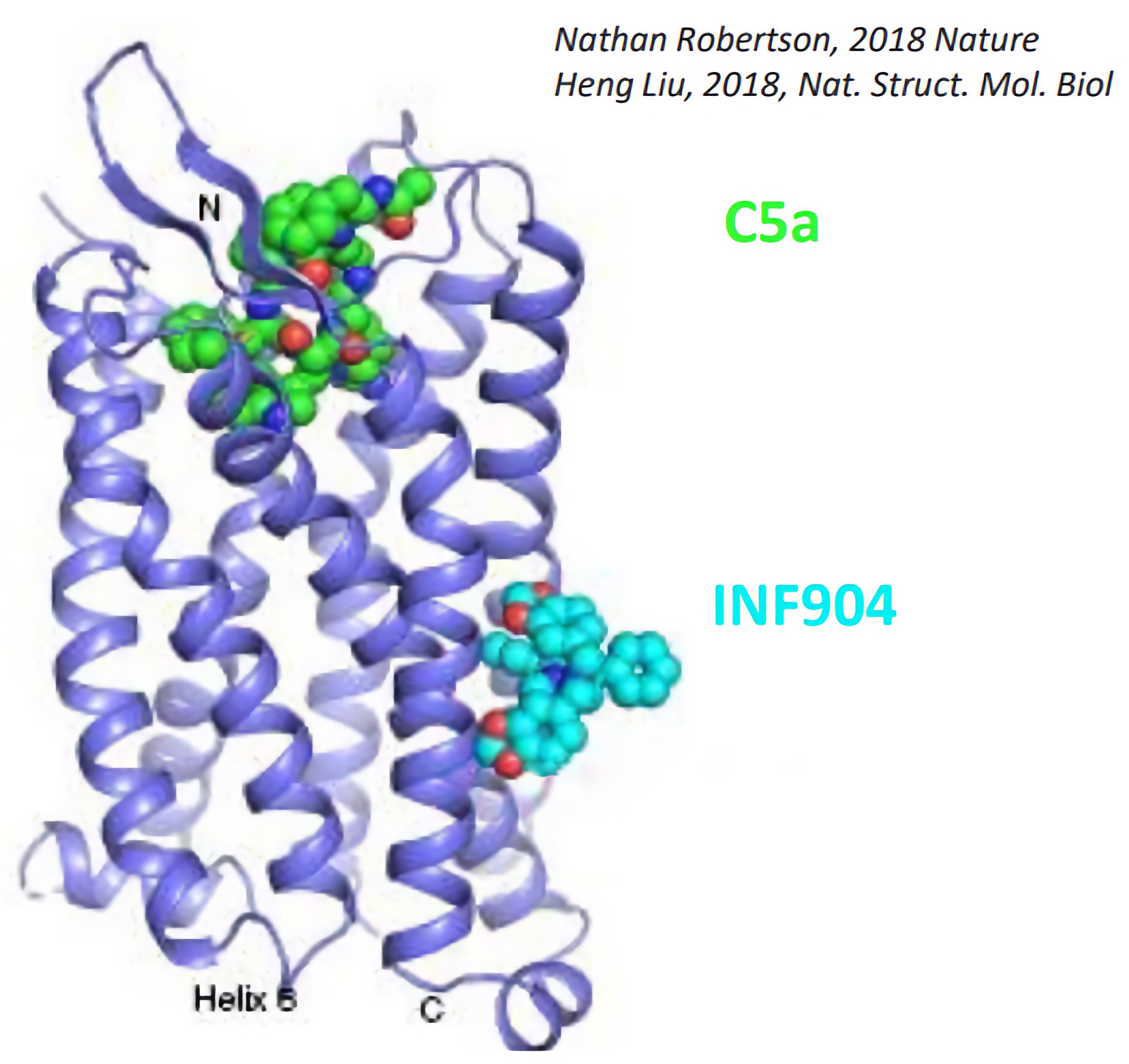
Izicopan is a potentially best-in-class oral, low molecular weight drug that targets C5aR with high affinity and selectivity; and binds to an allosteric site on C5aR1 within the lipid bilayer, antagonizing the binding of C5a to block induction of neutrophil activation. As a “pipeline-in-a-product” InflaRx is addressing complement-mediated, immune and inflammatory conditions with izicopan.
In preclinical studies, izicopan showed higher plasma exposure in animals, including non-human primates, and improved inhibitory activity in a hamster neutropenia model compared to the marketed C5aR inhibitor. Further, in contrast to the marketed C5aR inhibitor, in vitro experiments demonstrated that izicopan has minimal inhibition of the cytochrome P450 3A4/5 (CYP3A4/5) enzymes, which play an important role in the metabolism of a variety of metabolites and drugs, including glucocorticoids. Anti-inflammatory therapeutic effects in several preclinical disease models were also demonstrated by izicopan as well.
Reported results from a first-in-human study demonstrated that izicopan has best-in-class potential, is well tolerated in treated subjects and exhibits no safety signals of concern in single doses ranging from 3 mg to 240 mg or multiple doses ranging from 30 mg once per day (QD) to 90 mg twice per day (BID) for 14 days. Pharmacokinetic / pharmacodynamic data showed izicopan provided ≥90% blockade of C5a-induced neutrophil activation achieved over the 14-day dosing period. In addition, compared to the marketed C5aR inhibitor, izicopan showed ~3-fold higher Cmax and ~10-fold higher AUClast (at comparable dosing levels) and faster achievement of therapeutic exposures with a broad therapeutic index (at BID and QD dosing).
To leverage the strengths of izicopan’s pharmacologic properties against the substantial unmet need that exists in AAV, InflaRx’s izicopan AAV program is targeting the generation of multiple differentiating efficacy and safety data sets in a variety of AAV settings with different strategic goals.
InflaRx anticipates a randomized, double-blind, placebo-controlled Phase 2 trial evaluating two izicopan doses on top of standard of care, including rituximab and GC tapering. The current design contemplates approximately 35 patients per arm and 12 months of treatment, with key data readouts occurring at 24 weeks. Efficacy assessments are expected to include disease remission, renal function, proteinuria, hematuria and renal recovery endpoints alongside safety and other efficacy assessments, as well as GC use. The trial design will focus on AAV patients with defined renal involvement (renal vasculitis) and has been optimized to detect potential efficacy signals of izicopan on renal function and renal injury recovery when compared to placebo treatment.
In addition, InflaRx intends to initiate an open-label Phase 2 trial in newly diagnosed or relapsing AAV patients in need of remission induction therapy, exploring safety and efficacy in patients when replacing GC treatment. For this, a two-stage design is planned in which a rapid taper of GC is applied in Stage 1, during remission induction therapy (e.g., in conjunction with rituximab). Upon safety assessment, a planned complete replacement strategy will be explored in Stage 2. The trial will assess the ability of izicopan to replace GC treatment during remission induction without impacting patient safety.
In addition to its efforts in AAV, InflaRx anticipates multiple proof-of-concept studies with izicopan in rare renal diseases. The Company believes izicopan’s improved pharmacologic properties are applicable to the considerable unmet needs in these areas as well, including the potential for once-daily oral dosing, lack of membrane attack complex (MAC) inhibition, and lack of vaccine requirement.
Efforts in broader renal disease include the initiation of an investigator-initiated trial (IIT) in aHUS that is expected to provide initial select patient data. In addition, the Company plans to initiate a pilot study in patients with IgAN and IgAN rapidly progressive glomerulonephritis (RPGN). Signal finding studies in additional rare renal disorders are contemplated as well.
InflaRx has pursued two initial immuno-dermatology indications with izicopan, with data reported in HS and CSU in November 2025.
In the HS, across all dosing groups, izicopan induced rapid, meaningful and consistent reductions in ANs and dTs; in addition to improvements in measures such as HiSCR, IHS4, NRS30, and DLQI. Improvements in reported efficacy measures were largely rapid and consistent, be-ginning from Week 1, and deepened over the 4-week treatment period. All doses showed positive clinical activity and appeared strongest in the highest dosing cohort. The company believes efficacy data for izicopan at 4 weeks were largely in line with data reported for the same timepoint from clinical studies for approved HS therapies, and compared favorably for reductions in dT and improvement in NRS30 response.
Furthermore, initial data reported from 25 HS patients that completed the 4-week off-drug follow-up period showed that HiSCR responses continued to deepen 4 weeks after the treatment period. Preliminary PK results from Week 8 indicate izicopan levels 4 weeks off drug may still offer C5aR blocking potential. In addition, InflaRx believes inhibiting C5aR may drive an improvement in the inflammatory environment which may confer longer lasting benefit.
Safety data from 33 HS patients was reported. No signal of safety concern was detected, with no reported serious adverse events (SAEs) and three adverse events in two patients reported as possibly-to-likely related to drug which all were mild (Grade 1) in nature.
Overall, InflaRx believes these data are strong evidence that izicopan is highly active in HS, with improvements in efficacy measures largely differentiated from historically reported placebo, and in line with reported improvements at the 4-week time point for therapies which have successfully completed Phase 3 trials or received approval.
In CSU, reported improvements in clinical measures such as UAS7 appeared generally higher in the 60 mg dosing cohort (UAS7 change from baseline of -13.7 points at Week 4) and indicate a level of activity that exceeds average historically reported placebo levels, and is within the range of existing approved CSU therapies. Furthermore, in patients with severe CSU at baseline (UAS7 of 28–42, n=23), the 60mg dose reduced UAS7 by 15.4 points, and in patients who presented with angioedema (n=3) the reduction of UAS7 was 18.7 points. Additional efficacy analyses in patients with high IgE (n=22) and low IgE (n=6) at baseline showed that izicopan appeared equally effective in both patient populations.
Furthermore, initial data reported from 23 CSU patients that completed the 4-week off-drug observational follow-up period, indicated that patients continued to benefit from izicopan four weeks after the last dose, with responses in the 60mg dosing cohort showing a mean absolute UAS7 reduction of 16.7. InflaRx believes that izicopan’s ability to drive durable improvements within the inflammatory environment could provide deepened clinical benefit with long-term dosing.
Safety data from 33 CSU patients was reported. No signal of safety concern was detected, with no reported SAEs and one adverse event reported as possibly related to drug which was mild (Grade 1) in nature.
Overall, InflaRx believes these data suggest that izicopan is active in CSU and not only differentiated from reported historical placebo rates, but potentially within the range of currently approved CSU therapies. These data further indicate that UAS7 decreases may deepen with longer-term treatment.